Discovery Channel interview & sneak preview of the ocean boat!
Posted in 24hourHPBrecord, boatbuilding, expedition, training
Keel-girl in a BIKINI this time!


Then to see how strong (or lack of strong) my keel was, I got someone to hold onto the rudder and I rolled the work bench away while holding onto the keel and slowly letting more of it’s 90 lb weight fall down.
Holding onto the hull at the keel causes some serious twisting of the hull which wouldn’t be a stress that the boat would experience in water, so I didn’t let it go all the way. The join to the hull was solid – no visual bending at all, and the keel tube wasn’t bending, but I could hear some creaks coming from the fiberglass hull itself twisting.


Now all I have left before sea trials is:
1. Make a foam plug for the Dorade vent (When i tip WiTHiN onto her side to slide the keel on, a bit of water leaks through the Dorade vent).
2. Cover over the holes where the old outriggers used to fit into
3. Install my new manual windshield wiper
4. Add a latch to keep the vent fan onto the Dorade vent. I used snap-loc before and it kept falling off
5. I need to make a stainless ring to fit through my nose ring holes to tie a line to. I used to run the tow line through the stainless tube that is inserted through the nose-ring hole in the bow (and stern), but the edges of the tube cut through the tow line.
Oh – and A brand new interview with me is due to air on Discovery Channel tonight! It’s the one we shot out in Victoria during the first sea trials. Daily Planet if you are in Canada.
Posted in boatbuilding
Keel-girl back by popular demand


Anyhow, this 100 lb beast is almost done. To fill in the leading and trailing ends of the keel bulb, I mixed in my lead shot with Bondo and spread it into the steel sectioned nose and tail like I was baking Frankensteins birthday cake.

I’ll be heading back out to Tofino sometime within the next 3 weeks for more trials/training. One test I really need to do is to measure my power output, resulting speed and the exact wind speed so we can develop a power profile for WiTHiN to better predict her parameters in various wind conditions. It would be great to experience 30 to 40 knot winds.
I made some calls to see if I can hire a support boat to follow me out, and it might be tougher than I expected. When I was last in Tofino for the first sea trials, it was January and way-off season for the tourism industry. March is the start of Whale watching season, and I’ve been told that many of the boats are booked with tours.
Training
——————————–


Later,
gk
Posted in boatbuilding, training
Keel pin-up girl


Quotes for shipping WiTHiN to the Canary Islands are coming in at around $14,000 one way! And I have to drive it to New York. This is about double what I had budgeted. Then another $14,000 to ship her back from Antigua to Miami, and again, I would need to drive to Miami to pick it up. I also found out that I need to allow 7 week delivery time.
If I am to meet Nick (my support boat) for a November departure, I need to have WiTHiN shipped out by the beginning of August. I set a deadline to have the new boat built by Early June, but that was based on getting plans finished two weeks ago.
We have to finish the drawings, contract a builder, have the entire boat built, install all the hardware, and equipment and supplies and then get it out to Tofino for sea trials – all before August first. Oh, and then I have to drive for 3 days to New York.
Postponing for 1 year is something that I am seriously considering. One advantage is more time to seek that elusive major sponsor, and another advantage is more time to develop that sea experience that I am so lacking thereof. If I did postpone departure for a year, I would definitely plan some intermediate challenges.
————————–
Training
I had a 6 hour training ride scheduled for tomorrow, but the weather is going bad. Snow and a high of zero, so it looks like I’ll be riding inside for the day. Yeah! fun fun fun.
The good news is I got an iPod Touch for my birthday, so I plan on watching some TV shows, podcasts and YouTube while sweating away downstairs in my basement for 6 hours. Maybe hour 1 I’ll read my book (see what I’m reading on my FaceBook page – Greg Kolodziejzyk), hour two – play some Guitar Hero, hour 3 – a bit of email on the iTouch or Nomad, hour 4 & 5 – watch a DVD movie on TV, hour 6 – watch some YouTube videos on the iTouch. I can also listen to a couple of audio books I have started (Long Way Down and The Proving Ground), and some tunes.
Posted in boatbuilding, expedition, training
WiTHiN keel ballast pool test

I want to get back out to Tofino for more sea experience, and we decided that it would be wise to install a keel on the prototype boat to see how much it helps smoothen out the rough ride in the chop.
The first step was to determine how much weight is required on the end of the keel. My calculations showed about 100 lbs is required to offset my weight while climbing in through the top hatch, and I needed to verify this with an actual test in a pool.
I met John Mackay, Ben Eadie, my dad Rudi and Pat Lor at the YWCA on Thursday afternoon. It was a job getting WiTHiN through the SINGLE DOOR to the pool! I can’t believe we actually got it through that door. All of our measurements showed that it would be impossible, so we thought we would try it anyways. Unbelievably, we jammed it through that door!
Getting the bolt-on keel onto WiTHiN was super easy. Once she was in the pool, I just closed up the top hatch, and windows, rocked WiTHiN onto her side and used the pool deck to slide the keel onto the stub post already mounted on WiTHiN. I will use this same technique to mount the keel from the side of the dock when we get her out to the ocean again.

All of my weight is balanced over the side and
this is where WiTHiN stops her roll with 90 pounds on the keel.

Now I will remove the temporary weight plate tube from the keel and weld on a 3″ diameter x 24″ long stainless steel tube filled with about 90 pounds of lead shot. Then I’ll fair the keel strut and the ballast bulb, and it’s back out to Tofino!
Posted in boatbuilding
Sea trials part Deux

More sea trials:
According to the departure countdown widget in the upper right of this page, I only have 272 days, 8 hours and a few minutes before departure. YIKES!
I have a lot to do, but everything seems to be falling into place slowly, so I am still feeling relatively confident that I can make it to the start line in La Gomera, Spain in the Canary Islands in November.
One of my confidence builders is more time spent at sea in WiTHiN. I really feel like I need to experience some big seas – or at the very least, I need to spend a day pedalling for 8 hours straight up and over 2 to 3 meter swells which might be considered average Atlantic crossing conditions. High winds and some chop would be a bonus.

For sea trials part 2, WiTHiN will feature a ballasted keel instead of relying on ballast in the bottom of the boat. In the short video clip below, you can see how WiTHiN is thrown around quite a bit in the chop.
We’re hoping that 40 to 90 pounds of ballast suspended 3 feet below the hull will tend to soften the rough ride. It should also provide me with enough stability to stand up, enter and exit and I can get rid of those outriggers.

If this works, then I have faith that the new expedition boat which also uses a keel for stability is the right way to go.

In order to gauge how much weight to put in the keel, I have welded a temporary weight-lifting plate holder to the keel and I can slip on 10 to 25 lb plates onto the keel and test out stability while standing up in a pool somewhere. Once I figure out how much weight we need, I’ll weld the 3″ diameter stainless tube to the end of the keel tube and fill it with lead shot. Then I will round off the ends with bondo. It will be a bit draggy, but this prototype isn’t build to set any speed records.

The plan is to get back to Tofino THIS MONTH for more sea trials using the new keel. I will hire an RIB for safety and head directly West out into the open Pacific for 4 hours, then turn around and head back. I should be able to make at least 50 km total.

NEW FRAMED PRINT:
 Support Greg’s quest to become the
under his own power with a
$250 “Across With Greg”
Small Business sponsorship that includes
YOUR LOGO on the boat “WiTHiN” + this super cool plaque.
Ordering is easy – click here: http://www.cafepress.com/sponsorgreg/3918769
Posted in boatbuilding
Live Life!
Live your life to the FULLEST. Susie did.

Canmore resident Susanna Lantz was skiing with a friend in an area known as Chickadee Pass, on the south side of the Great Divide bordering Banff and Kootenay national parks, when an avalanche swept down the side of the mountain around 4 p.m. prematurely ending the life of this wonderful 28 year.
Helen and I met Susie a couple of years ago on our Oregon coast bike trip. She was this amazingly energetic and enthusiastic spark who was living her dream by cycling from Vancouver to the tip of South America. We spent a day with her, then we split off and wished her the best of luck on her adventure.
Her unfortunate story made the front page of the Calgary Herald and Helen recognized her face, and I recognized her name. A few minutes spent digging through photo archives of our Oregon trip resulted in a sad confirmation – it was indeed Susie.
Susie – your positive attitude, energy, enthusiasm and zest for life was infectious, and you will be missed.
————————————
Ocean WiTHiN progress:
I am happy to report that we have contracted a naval architect to produce working drawings of Ocean WiTHiN. Stuart Bloomfield from Bloomfield Innovations will be talking the basic dimensions from my overview and drafting plans that will go to a composite fabricator for construction. I am considering a few builders now.


Oct 15th – WiTHiN and I arrive in La Gomera
Sept 1 – deliver WiTHiN (fully provisioned and equipped) to the
transport to Canary Islands
Aug – second sea trials
July – first sea trials
June 30 – WiTHiN ready for sea trials (equipment, electrics,
June 1 – WiTHiN bare-boat built
March 1 to 7 – plans delivered to boat builder


I made cardboard cutouts of the various Lewmar port lights and sat in the mock-up to figure out exactly where these windows should be placed. I plotted a horizon line on the coroplast canopy and shifted my view by moving my head forward, back, right and left such that I could get a full 360 degree view around me to watch for other ships.
————————————
TRAINING

I am still planning on another attempt at the 24 hour human powered boat distance record for early June. As I have said before, this intermediate challenge motivates me to start taking my training seriously now! After the 24 hour event, I will be perfectly situated to start some seriously long distance training which will get me ready for the ocean crossing.
My long rides have been inside in the little red coroplast playhouse trainer, but the weather here has been marginal for outside rides, so I cleaned up the M5, and in an hour I’ll be heading out for my 2nd 5-hour outside ride with my buddy Dr. Chad Anker who is training for Ironman Coeurdalene.
————————————
24 HOUR RECORD ATTEMPT
As you know, I will be building a brand new human powered boat for the 24 hour ‘Pedal vs Paddle’ challenge. This is Rick Willoughby’s tried and tested design, so there shouldn’t be much time consuming R & D involved in this build. Jarrett Johnson is CNC machining the hull and outriggers out of solid foam right now. They should be finished next week. Ben and myself and whoever else we can grab to help will be adding carbon and Kevlar to the foam hulls. Then a drive frame and seat goes on, rudder, prop and I’m done – ready for testing in the nearest unfrozen lake to Calgary.

I had purchased a bunch of Chrome Alloy to fabricate the drive frame with, but decided to build it out of aluminum instead. I’ve welded aluminum before, but I lost faith in my welding skills when a simple bracket I made failed at the weld. I thought I would give it another try.

I welded up a test join -two tubes about the same wall thickness as the tubing that I planned to build the frame out of. The welding very surprisingly well and I smashed the test part with a hammer as it was held in my vice and it failed on the tube – not the weld. Good news. So I went for it.

I am VERY happy with the result. It weighs 2 pounds without any hardware, pedals, etc. My seat weighs 3 pounds. I need to add a bracket for the right angle gear box kindly provided by one of my sponsors MitrPak, a shaft, the prop (we’re hopefully getting this CNC machined), aluminum frames for the seat back and outriggers and the rudder.

I am really trying to have this new boat ready for water testing in March sometime. If it tests out as expected, then I will ‘pull the trigger’ and officially announce the race.
In March, I also want to get back out to Tofino for another round of sea trials in the prototype WiTHiN using a keel which I still have to build.
So much to do, but I am hanging in there! Susie will be my inspiration for March.
Posted in 24hourHPBrecord, expedition, soapbox, training
TWICE as fast as rowing?

I did some additional calculating, and I think I have come up with the following ESTIMATE: There is a 5% chance that my crossing could be either 66.5 days or 21 days, and a 95% chance that it will be 36 to 44 days. Here is the logic behind this estimate – please let me know if I have made any errors:
I know for sure that WiTHiN will be able to maintain an average of 7 to 8 kph for at least 12 hours per day based on my known power output capabilities are over a 24 hour period. I also know that I can expect an average surface current speed of .8 kph for 24 hours of every day. Using the simple calculations below, this was how I had estimated my record breaking 40 day finishing time:
Ocean Surface Current = .8 kph x 24 hours/day
= 19.2 km/day x 40 days = 768 km
12 hours of pedalling per day @ 100 watts, 8 kph
= 96 km/day x 40 days = 3840 km
Total distance covered = 4608 km
But what I don’t know for sure, is how wind and weather will effect my progress predictions. So, I decided to run an analysis using the 35 solo Atlantic tradewinds route (Canary Islands to West Indies) ocean rowing expeditions since 1969 from the Ocean Rowing Societies web site.
First of all, lets see if we figure out what the average speed of an ocean rowing boat is, and how that compares to actual rowing times.
The fastest solo ocean crossing (tradewinds route) in an ocean rowing boat is 42 days, the slowest is 133 days and the average of every crossing since 1969 is 82.7 days
From research of previous ocean rowers including reading archives of trip logs, the many books I have read and my communications with many of them, it seems that the average speed observed by ocean rowers while underway is about 2 knots. That converts to 3.7 kph. If we subtract the ocean surface current of .8 kph, we get an actual unassisted average speed of 2.9 kph (this compares to my unassisted average speed of 8 kph).
Let’s see if my observation of the average rowing speed works out to the total distance using an average of 12 hours of rowing per day and the ocean surface current of .8 kph:
La Gomera, Spain to Antigua = 4500 km
Ocean Surface Current = .8 kph x 24 hours/day
= 19.2 km/day x 82.7 days overall average = 1587 km
12 hours of ROWING per day @ 2.9 kph
= 34.8 km/day x 82.7 days overall average = 2877
Total distance covered = 4464 km
So, it looks like my estimate of 2.9 kph average rowing speed without current works out to predicting the overall average time to cross the Atlantic by row boat. Therefore, my estimated crossing time of 40 days should be pretty accurate.
Error bars
Now lets calculate the standard deviation and error bars of all solo ocean rows and apply that to my 40 days to see what the maximum and minimum crossing time could be:
Total crossing time = 2896 days
Average crossing time = 82.7 days
Standard Deviation = 24.11
Error: stdev/(sqrt(count)) = + – 4.076 days
Using this standard deviation, I would expect that my crossing could take from 36 days to 44 days (approximately). Actually, that is not right… Since my average predicted crossing time is approximately 50% of the average rowing time, I think that I would need to take 50% of the rowing error which could be + – 2 days, not 4. But I’ll use 4 to be conservative.
Anyhow.. I’m a bit rusty on my stats (it’s been a while). What would the confidence level be for a 36 to 44 day crossing? 95% ??
Another way of predicting how the random chaotic nature of the weather could effect my crossing would be to simply take the maximum rowed crossing of 133 days, and divide that by my average speed compared to rowing averages (66.5 days maximum), and the fastest rowed crossing of 42 days (21 days minimum).
To summarize, we could say that there is a 5% chance that my crossing could be either 66.5 days or 21 days, and a 95% chance that it will be 36 to 44 days.
Posted in expedition
Hurricanes and illegal departures

I have been running around in circles trying to secure a safety boat for my human powered transatlantic record attempt schedule for December 1, 2008 – only 282 days away according to my countdown timer posted at the Pedal the Ocean web site.
According to the Ocean Rowing Society’s statistics page, a total of 80 individuals have rowed across the Atlantic ocean East to West from Canary Islands to the West indies this 2007-2008 season (this includes 5 who are in the process of rowing as I type). There were 7 solo rowers, 17 duos, 5 groups of four, one group of 5, and one group of 14 rowers who set a new human powered crossing record of 33 days, 7 hours, 30 minutes (this was a group of 14 rowers! How I would LOVE to break that record as a solo!)
Most of these crossings were participating in the Atlantic Rowing Race 2007, an race organized by Woodvale Challenge. The race entrants are followed across by a support boat, and there are rules regarding the kind of support that would constitute a disqualification, and in those cases, the teams are allowed to continue the crossing, but would be either disqualified from the race aspect of the event, or assessed a penalty. For example, in the 2005 Atlantic Rowing Race, Jo Davies from the all girl team called Rowgirls decided that she was unable to continue due to hurting her back when she fell. She left the race by boarding the support boat after 45 days at sea. The Rowgirls team was disqualified from the race, but the three remaining girls continued to finish their journey and eventually arrived in Antigua. (Jo Davies returned this year and finished the race with another 4 person, all girl rowing team and they broke the womens record by 10 days!) Another example of a rower seeking support is Peter Collette on Atlantic Pete who took a package of antibiotics from the support boat during his solo crossing this year. Since there were only two solo rowers in this years rowing race, Woodvale gave the second rower Canadian Paul Attalla the option to have Peter disqualified. Since Peter didn’t end up consuming any of the medication, Paul honorably recognized Peter’s solo division win.
For me, this ocean crossing is not a survival adventure, it is about setting a speed record. If the peace of mind that comes with a safety boat near-by allows me to focus on my first goal which is to make it across the Atlantic ocean as fast as I can, then I think the investment is definitely worth it. Just like the Atlantic rowing races, if I need support from my follow boat, say repairs that I am unable to make, or a re-supply of food or water, then I would disqualify myself from any claim on a speed record, but I would still continue to make my way across if possible.
There are many rowers – even solo rowers who cross every year without the security of a follow vessel. If they run into trouble, they reply on the local coastguard for a rescue. Essentially, rowers who use a support boat are assuming most of this responsibility by paying for their own rescue and not relying on the state to provide it.
I have a number of options regarding a support boat, and none of these have panned out so far – except one which looks very promising. Here is a quick run down:
2. Buy a yacht and sell it when I am finished. This could work, but selling a yacht isn’t like selling your car. It could sit in an expensive marina slip for YEARS before it sells, and the loss due to depreciation plus maintenance and moorage costs would be substantial.
3. Buy a yacht and keep it. Sailing the world on our own yacht is a future that Helen and I have discussed and might be interested in exploring someday, we are nowhere near ready to take that step. Also moving the yacht to the Vancouver Island area from the West indies would be very expensive as would the moorage fees, maintenance and up keep once it finally gets here. Keeping it and chartering it out through a charter firm might be an option, but again, I’m just not sure I want to get into that business right now. I need to focus my energies and time on the crossing, not investing in a yacht.
4. Find someone who is sailing across from the Canaries to the West Indies at about the same time as I plan to make my crossing. This is the option that makes the most sense. The average sailing yacht takes about 3 to 4 weeks to cross the Atlantic and I am hoping to do it in 6 weeks. I can pay a fee which would make the extra crossing time required of the support yacht worth their while. The problem with option 4 is finding someone – like finding a needle in a hay stack. I have send hundreds of emails to sailing communities, yacht brokers, marinas, posted in sailing forums, placed classified ads in magazines, and nothing has resulted in any prospects.
Until just yesterday. Rob Hurrell who is my support boat advisor in the Caribbean knows of a world circumnavigation sailing race called Around in Ten. You have to check out this web site – imagine this: A single handed sailing race around the world in boats that cannot exceed 10 feet. Your car is longer than 10 feet. I got in contact with the races organizer Nick Dwyer who will be travelling to the Canary islands to pick up his A 38ft steel Roberts Spray yacht that Nick will skipper as support boat for the around-in-ten race. He needs to sail the support boat from the Canaries to the Caribbean for the start of the around-in-ten race in early January.
 Nick Dwyer and his new 38 foot support boat
Nick seems interested in helping me out, and we are working out the details. The fit between our two projects is perfect and the timing is almost perfect. Nick needs to leave the Canary islands no later than November 15. My planned departure date was December 1. Leaving two weeks early shouldn’t be a big deal, but there is more to it that you would think.
The first problem is the Spanish coastguard has issued a list of port clearances for ocean rowers. The requirements are all reasonable except for the life raft. My boat is too small for a 4 person approved life raft and I will be followed by a support boat, so I don’t see it as something necessary for me to carry. The other problem is they won’t allow you to leave until after December 1. Nick wants to leave on November 15.
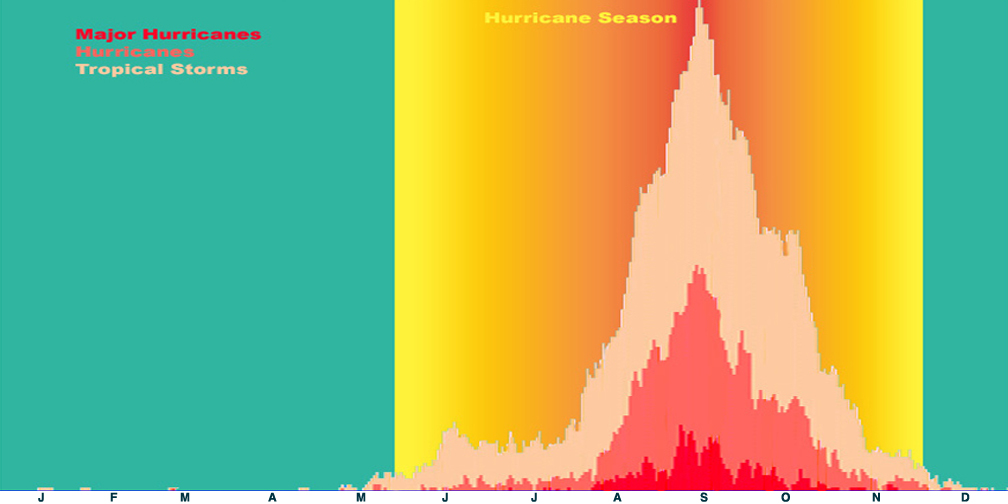
The second problem with an early departure is the reason why the Spanish won’t let you leave until December 1, which is the official end of the hurricane season.
Nick and I have been looking at the hurricane risk as it pertains to our Atlantic crossing, and it appears that a November departure could be pretty safe. Here is a plot showing the number of hurricanes and tropical storms throughout the year showing the ‘season’ from May 1 to Dec 1:
http://www.aoml.noaa.gov/hrd/tcfaq/yearly2.jpg
 click to enlarge
Specifically, along my intended route, since 1991 there have been few hurricanes or strong tropical storms in the North Atlantic during the month of November, and very few during the month of December. None of the November storms were on the tradewinds route (my route from Canaries to Antigua). Almost all of the storms occur in a zone from the center of the Atlantic to the west side, and North of 10 degrees. By the time we reach the western side where these monsters generally spawn, it will be December and the number of storm occurrences decreases substantially. Here is a list of all the serious storms that occurred in the North Atlantic over the last 17 years in the months of November and December
Hurricane Epsilon – Nov 29 to Dec 8, 2005 – far north of my route
Tropical storm Zeta – Dec 30 to Jan 6, 2005 – far north of my route
Tropical storm Otto – Nov 29 to Dec 3, 2004 – far north of my route
Tropical storm Odette – Dec 4 to 11, 2003 – north of my route
Tropical storm Peter – Dec 7 to 11, 2003 – near the mid point of my route (slightly north)
Hurricane Olga – Nov 24 to Dec 4, 2001 – far north west of my route
Hurricane Nicole – Nov 24 to Dec 1, 1998 – far North of my route
You can view a historical plot of all north Atlantic hurricanes and strong storms and their paths from 1995 to 2007 at this NOAA page: http://www.nhc.noaa.gov/pastall.shtml
According to my analysis, if I had departed Canary Islands on Nov 15th in any of the 17 years from 1991 to 2007, I would not have encountered any hurricanes, tropical storms or tropical depressions. I would have come close to tropical storm Olga in 2007 at my destination, but it would have taken a 28 day crossing, and I would have been about 100 miles south of tropical storm Peter in 2003 at my mid-way point. That results in an 11% chance passing by the proximity of a tropical storm, but no encounters with a tropical storm and far from any hurricanes.
In the days prior to the Spanish coast guard December 1st departure regulation, from 1969 to 2004 most of the Canaries departures by ocean rowers occurred in October. Half way through October, the major hurricane risk diminishes quite substantially, but the hurricane and tropical storm risk is still quite high. Here are the number of rowing departures during the hurricane season:
August: 1
September: 2
October: 82
November: 6
So – back to Nick, my support boat, and the Spanish coast guard. Am I will to risk encountering a hurricane by leaving on November 15th? Yes – no question. I think the risk is negligibly higher than departing on December 1. Am I willing to ‘sneak-away’ from the Spanish coast under the cloak of darkness until safe in international waters? I don’t know.
Another ocean rower (who will be unnamed) who has tangled with the Spanish coast guard has advised me to skip the permit application process all together and just leave incognito – regardless of what month I plan to leave. What are the risks?
On December 20, 2006, the Spanish coastguard stopped and searched Graham Walters row boat “Puffin” 8 hours after he departed La Gomera in the Canary Islands. They searched his boat and found a couple of pieces of equipment that they claim didn’t comply with regulations. They impounded Puffin and demanded $45,000 to release the boat. They later reduced the amount to 6000 euros which Graham paid.
That same day in 2006, 2 other solo rowers were also towed back and fined. They all eventually departed and made it across, but not without fighting with the authorities and paying fines. Ed Baylis and Stu Turnbull were too fast for the coast guard to catch and they got away.
The fine for not informing the harbormaster of your departure is 1000 euros.
The port clearances from Woodvale are here:
http://www.woodvale-challenge.com/index.php?page=84
I’ve been told that leaving a small port like La Gomera or El Heiro without being noticed by the coast guard who are stationed in Tenerife isn’t difficult. The publicity that the large rowing races generate attract the attention of the coastguard, but ‘quiet’ departures can go unnoticed. Am I willing to take that risk? I think I need to get in touch with someone who can negotiate an approved early departure for me with the Spanish coastguard and at least make an attempt to play it safe and be legal. However, this is not something that I can leave until the last minute. I will need to get advanced clearance so I can come to a firm agreement with Nick to support me.
A Nov 15 departure could be problematic for me on another front – that is, to have the boat built, tested, fitted out, supplied, delivered and ready to go by Nov 15. Ugh! so much work to do, and I need to get it done right away!
Posted in expedition
My little red Coroplast playhouse

The new design for the ocean crossing version of WiTHiN is here:
http://docs.google.com/View?docid=d5fpqr2_97f4fxz2fb
 I am still working on nailing down the exact measurements, and in order to learn about what those measurements need to be, I built a wood and coroplast mock-up trainer:
 The sliding canopy works exactly the same way it will on the actual boat.

I can reach my bow storage compartment by leaning forward and crouching right in front of the drive leg. I will cover the hatch opening with a pull-off kayak-type hatch instead of a hinged hatch because the swinging door would interfear with the drive leg.
 I can access the stern sleeping cabin through a Lewmar hatch that I cut out of plywood by opening up the sliding canopy cover, standing up, turning around, opening the hatch door downward, and sitting with my legs through the hatch opening. If need-be, I can also enter the hatchway with the canopy closed by lying on my stomach and entering head-first.

The problem I had with entering the cabin head-first in the prototype WiTHiN was that once I was in the stern cabin there was no way to turn around again. I need to sleep with my head toward the hatch and the cockpit.

 Behind the seat is an enclosed storage copartment that will hold the water maker, and sea anchor. One of the features of the sliding canopy cover is I can kneel up on the storage compartment to deploy the sea anchor to the stern. The forward wall of this compartment behind the seat is sloped with storage bins accessible while seated.

There is a smaller perimiter deck in the gunwales that will hold the steering handles and sliders. I can store things in these arm rests as well.
Since all supplies and equipment are kept in water-tight compartments, the cockpit can get wet, splashed with a wave, or completely flooded. There will be an electric bilge pump in the foot well which is the lowest part of the cockpit.
 I still need to build-out the walls for the rear sleeping cabin and experiment with those dimensions to make sure that it is comfortable enough and that I can move around in there. I also need to figure out where the horizon line is when seated and looking out the front window so I can draw where the port lights (small side windows) need to go. I need to be able to see 360 degrees from my seat to spot other boat traffic. This doesn’t mean that I need a contiguous window all around – I can move my head right to left and forward to back to expand my total field of vision through each window. I want to use a transparent hatch cover for the sleeping cabin so that I can see through it and hopefully see through the rear window as well – something else to experiment with.
When moving around in the cockpit and into the rear cabin, the seat is in the way. I need to figure out some way of either easily moving it out of the way, or folding it down. I would rather move it right out of the way because it makes standing up in the cockpit and reaching things stored in the bow compartment a lot easier. Any ideas?
My seat is now higher also – in fact high enough off the hull bottom that I will be able to remove the seat to squat over a toilet bowl – something else to experiment with. No, I won’t invite you over to train with me on that day.
Training – foot numbness, hours and power
And finally some really good news – with the new higher seat position, some super-lose shoes, and exagerated ‘circling of my legs’, my feet are no longer going numb.
My training hours in my little red playhouse are now up to about 10 hours per week. I am in base-building phase right now preparing for the 24 hour ‘pedal vs. paddle challenge’ in June. I always start each training season out with a maximum 20 minute effort which serves as a baseline to measure any fitness improvements as my training season moves forward. A sad 250 watts was measured – but I expected this. My peak 20 minute power output has been as high as 309 watts on my triathlon bike.
Pedal vs. Paddle Challenge
I am still moving forward with the Pedal vs. Paddle 24 hour human powered boat distance record attempt and race for early June. I have a new design from Rick for his fastest boat yet – V11G:

Jarrett Johnson from Innovention Technologies in Weyburn Saskatchewan is CNC machining the styrofoam hull and outriggers. My friend and PTO sponsor George from MitrPak is providing the gear box. I’ll be doing the carbon fiber composite work, and metal fabrication myself.
I plan on building a web page to announce the race and make it official, but I think I want to get the boat finished first just to make ultra-double-extra certain that it is as efficient as it should be – that is, that I didn’t make any construction blunders resulting in a sluggish boat. Not only is Carter Johnson going to join me in the race, but I am also interested in inviting a couple other types of human powered boats to race with us. A rowing skull, an outrigger canoe and maybe another kayaker. It should be pretty interesting!
New T-shirt design:

Be part of a WORLD RECORD Support Greg’s quest to become the fastest human to cross the Atlantic ocean under his own power with a $100 “Across With Greg” sponsorship that includes YOUR NAME on his boat “WiTHiN” and this super-cool T-shirt!
http://www.pedaltheocean.com/sponsorship
Posted in boatbuilding, training
 Adventuresofgreg's Blog