Posted by: adventuresofgreg | July 25, 2008

GEEKMOBILE

Ya, I know. What a dork huh?

I met my buddy Bryon Howard at the Heritage Park docks at Glenmore reservoir to help me launch the new floating geek-mobile. I chose the Heritage docks because they are usually fairly deserted aside from a few guys trying to catch fish from the dock. I seriously did NOT want anyone to see me in this! Especially the competitive rowers and kayakers that I race around the reservoir all the time.

I knew it wouldn’t work and it didn’t. My average speeds were way down due to the weight of the silly fairing contraption. It was pretty calm, but there was a section of the lake that was windy and my speed decreased just as much as it usually does when I passed from the sheltered area to the windy area. After a few loops we tore off the fairing and did another couple loops unfaired as a control. Results below:

With fairing @ 150 watts = 11.2 kph
Without fairing @ 150 watts = 11.5 kph
Wind: calm sections, 5 kph sections

I know that the benefit of the fairing should really only be for moving into head winds, but from these tests, I think that the weight of the fairing during calm waters would defeat any benefit the aerodynamics of a fairing would offer for the windy portions of the ride. My gut feeling at this point is to focus on weight shaving rather than wind shielding.

That said, our calculations still predict a net overall gain if the full fairing weighs less than 10 lbs. I think this could be possible with an aluminum wire frame/mylar covering. But, I think the gain would be very small and might not worth the time or effort.


Here is a photo of Rick Gritters streamliner HPV. The photo shows it with a heat shrunk mylar covering, but I think Rick used aircraft Dacron wing material as the final cover. He says the bike weighed in at 40 lbs, so I would guess the fairing itself might be about 10 lbs.


———————————–
Friday, July 25th report and a comparison to last years record attempt:

I was on the lake for 3 hours today. The objective was non stop and to maintain 150 watts. It was fairly windy – 10 to 15 kph and quite wavy for most of the 3 hour ride. My SRM battery died after an hour, so I don’t know what my ending power average was, but it was probably between 140 and 150 watts. My speed however was very low – 10.5 kph. There were quite a few stops due to weeds collecting on the prop and wrapping around the bow. These stops were probably responsible for .5 kph of the average. Still, without these stops, I would really only have been at an average of 11 kph. 10.2 kph is record pace. Calm water is a very important factor.

I looked back at last years blogs to see where I was during training for last years pedal boat record attempt. On May 18th I finished a 10 hour day on Glenmore reservoir. I reported that it was very windy at times, and dead flat at times. I was pedaling an early version of WiTHiN which is based on a double kayak with a recumbent seat, pedals and a propeller. I finished the 10 hours at 7 kph average speed which was right at the 168 km record I was training to break. This compares now to an entire day spent on the water with CP2 and ending with an average of 11 kph (I am using the average speed from my 5.25 hour training day because it included both calm and windy periods just like last years comparison training day) which is 264 km in 24 hours, which is 22 km over the current record of 242 km. This is encouraging.

WiTHiN-24 from the 2007 HPB record attempt

To summarize, my long training day average speed from last years boat WiTHiN was right at the record pace, and this years long training day average speed on CP2 is slightly over the record pace.

Also, here is how both boats average 150 watt speeds compare to their respective records they were design to break:

WiTHiN 150 watt speed = 9.2 kph
24 hour record = 173.76 km
Theoretical 150 watt 24 hour distance = 24 hours * 9.2 kph = 220.8 km
150 watt efficiency over the record = 127%

CriticalPower2 150 watt speed = 11 kph (average water and wind)
24 hour record = 242 km
Theoretical 150 watt 24 hour distance = 24 hours * 11 kph = 264 km
150 watt efficiency over the record = 109%

CriticalPower2 150 watt speed = 11.5 kph (calm water and wind)
24 hour record = 242 km
Theoretical 150 watt 24 hour distance = 24 hours * 11.5 kph = 276 km
150 watt efficiency over the record = 114%

CriticalPower2 150 watt speed = 11.8 kph (mirror flat)
24 hour record = 242 km
Theoretical 150 watt 24 hour distance = 24 hours * 11.8 kph = 283.2 km
150 watt efficiency over the record = 117%

As you can see, this comparison shows that it will be more difficult to break the 242 km record in CP2 than it was to break the 168 km record in WiTHiN. However, my training day average now shows a higher average speed relative to the respective record than last years training day average.

“At some point you have to put the calculators down and just go for it.”
Greg Kolodziejzyk

Posted by: adventuresofgreg | July 22, 2008

3 hr fairing test


This is what the wind sees

I spent 3 hours on the water Monday non-stop at 150 watts with the front and rear fairings on and my overall ending speed average was quite disappointing. I ended up at 145 watts and 11 kph. The wind was very calm for Calgary – long periods of very calm with pockets of 5 kph wind and ripples to 10 kph gusts with a bit more roughness in the water, but over all a very good example of a calm weather day – probably about as good as I could expect for an entire 24 hours.

I don’t think the fairing did a thing, but it is hard to say for sure. Compared to the last 5 hour non-stop run where I ended at 160 watts and 11.4 kph average. The first 3 hours were very calm like Mondays test and my average was at 150 watts and 11.3 kph average – this compares to 11 kph from Monday in the same conditions, but with the added weight of the fairing shell on CP2. All that said, it is still hard to say for sure because I was continually pulling weeds off the prop. My speed can slow down by up to 1/2 kph or more when there is a weed on the propeller. There are sections of the reservoir where large patches of weeds are growing right up to 6″ of the surface. It’s a major pain.

I need to clarify a few of the reasons regarding testing of a fairing, as I’ve been getting quite a few emails. I know that at low speeds of 10 km/hr, the aerodynamic drag reduction from a fairing won’t provide much additional speed. I am also aware that my fairing only went half way in creating a really good, smooth airflow over the cockpit because it stops abruptly before the pedals and starts again right behind my back. The reason why we think it could help is mostly due to reducing the effect of pedaling into any head wind. This is the same reason why WiTHiN human powered ocean crossing boat is fully faired. When I am moving forward at 10 km/hr into a 15 km/hr head wind, the apparent speed of the hull through the air is 25 km/hr and at 25 kph, a fairing is very effective.

For those of you reading this who aren’t aware of my previous project, I did play a large role in the design and development of Critical Power human powered vehicle where I set a 24 hour distance record of 1041,24 km by circling a 1/2 mile oval race track in Eureka, California in the summer of 2006. When Ben and I designed the fairing shell for Critical Power, we ran various shapes through CFD software to test and refine the shape.


Also – about comparing my faired human powered boat performance to Carters unfaired effort, I don’t see any reason why a fairing would be considered cheating or some kind of unfair advantage. One of the advantages of pedal/propeller power over paddle power is that we have the option to encapsulate the driver because there are no large paddles or oars that extend out from the boat that need to be allowed for. A large benefit of the pedal/prop platform is that it is more aerodynamic to start with due to the lack of the draggy paddles, so why not build-on that as a feature? I mean, that is the whole idea behind my pursuit of what can be accomplished using human power and some open minded innovation.

Hopefully technology that we develop and demonstrate will inspire new attitudes toward pursuing energy efficient boats and vehicles. Human power is about doing more with less rather than our current gluttonous attitude of doing more with more.


My buddy Gary takes CP2 for a spin
Posted by: adventuresofgreg | July 21, 2008

fairing test and 10 mph!

Because I realize that dealing with some wind for most of the afternoon during the 24 hour distance record attempt is going to be a given, I decided to test out a fairing. At 10 km/hr, an aerodynamic fairing won’t help very much, when when I am pushing CP3 10 km/hr into a 10 km/hr head wind, my apparent speed is actually 20 km/hr, and at 20, the advantages of a fairing could be substantial.

The fairing was easy to make – just a thin PETG clear plastic sheet curved over a curved plywood bulkhead. I had a few large sheets of PETG in the shop from when I was making canopy domes for Critical Power streamliner. Both the front and rear fairings took me a total of a few hours to make.

The test was the same loop I did at the reservoir on Friday at 150 watts and my average speed was 11.5 km/hr. This is .1 km/hr faster than without the fairing. That’s only about 2.4 km over 24 hour and only 1.2 km if half the day is calm. It was typically windy with some calm periods. I would say periods of 10 to 15 km/hr winds with patches of calm.

At this point, I can’t say for sure that pursuing this fairing is worth it. I will experiment with additional fairing to fill in the area behind my seat and possibly some additional covering for the sides of the cockpit. Over 24 hours including some calm periods where a fairing would not help at all, I would say the weight of the fairing which increases the displacement could result in a SLOWER over all average.

I can still set the entire boat up at the car in the parking lot and carry it on my shoulder down to the dock.


Here is a video of me hitting 10 miles per hour (16 km/hr) in CP3.
I’m not sure why the image is so washed out.

I decided to maintain 400 watts as I approached the dock and got Gary to film this. I hit 16 km/hr then the prop flexed up so high it struck the hull. I’ve done 15 km/hr before and the prop clears the hull – I guess 16 is the limit for now unless I lower the angle of the shaft and gear box. I think I could hold 400 watts for about 4 minutes which means it might be possible for me to average 16 km/hr for 1000 meters.

Mixing it up with the rowers

My buddy Gary was with me and here’s a photo of him taking CP2 for a spin. The fairing might not help the speed all that much, but it sure looks cool! It would look even better if it was painted silver with a giant Critical Power 2 logo on the side.


Posted by: adventuresofgreg | July 19, 2008

6 hour trial results – not great

I got out to Glenmore reservoir yesterday for a ‘race-day’ simulation. The goal was to maintain my target wattage non-stop for 6 hours following a GPS route that I plotted on my Garmin etrex using Google Earth. I would then have a really good idea how close I could get to Carters 242 km kayak record using this real-world test data and extrapolating my result out to 24 hours.

It’s very close, but probably slightly UNDER Carters record at this point. My average power was 160 watts and 11.4 km/hr average speed. I plugged these numbers into Ricks excel calculator and came up with an expected average speed of 10.1 km/hr for 120 watts which is the average power I hope I could end up with for 24 hours. This is a total of 242.4 km – almost smack dab exactly what Carters record is. BUT, I didn’t allow for the difference between my actual track and the surveyed course. Since I would be rounding the marked course to the outside of the buoys, I will end up travelling further than I am given credit for. I was also able to measure this ‘slippage’ and it works out to about 1.9%. Adding 1.9% to the total distance of 242.2 km would mean that just to EQUAL Carters record, I would need to go 246.8 km – an additional 4.8 km, or .2 km/hr additional average speed (significant). I think I can reduce the slippage but it would mean more buoys in the water marking out a rounder, smoother course. One of the reasons my slippage was so high was because I had plotted a GPS course using very few waypoints which meant that my corners were sharp. You can see in the image above how far my track veered off of the course.

The other issue with the projected 10.1 km/hr average speed is that it is based on ending with 120 watts of average power and so far, my peak average power for a 24 hour event has been 115 watts. 155 watts would convert to 10 km/hr + 1.9% slippage would equal 235.4 km. This is 6.6 km short of the record.

My average speed would have been higher if there was no wind, but for the first 4 hours of yesterdays test, the wind was pretty calm – probably about what I could expect for a day of very calm weather in Calgary. Probably 5 to 10 kph wind with periods of flat calm and periods of ripples. At the 5 hour point the daily poltergeist thunder storm blew in and I barely made it out of the water before all hell broke loose. I was racing back to the dock with 2 foot whitecaps breaking all over the deck and got slammed head first into the dock because I couldn’t stop. I had placed a new 62 tooth front chain ring on my cranks and my chain pulley wasn’t tight enough to allow me to back pedal, so I had no breaks.

My average speed also would have been a bit higher if I weren’t carrying so much additional weight. Since I was by myself on the water yesterday for 6 hours (cut short by 45 minutes due to the storm), I had to carry 6 hours of water, food, some extra clothes, a life jacket (got in trouble from the patrol boat the other day about not having a PFD on board), etc. I figure I was carrying an additional 15 pounds which is quite a bit. Without that additional weight, I might expect 11.4 km/hr at 150 watts of power rather than 160 average watts. This would equate to 10.4 km/hr at 120 watts average power (249.6 km total), and 10.1 km/hr at 110 watts of average power (242.4 km total).

Jeff posted a comment regarding the rules, GPS data and the surveyed course to this blog post that I thought was rather important, so here it is along with my reply

  1. Now, if you could keep an average speed of about 13.0 km/hr for 120 watts, I might win the computer.
    seriously though Greg, what ever the end result, you will still be a winner to us that are rooting for you.
    The course you will be going around. Will the actual distance be taken from how many laps you complete in 24hrs or will they accept a GPS reading as it is in basically still water?

    Jeff in the UK

  2. # Blogger Adventures of Greg 6:04 PM

    Jeff: The IHPVA will only accept the # of laps I make around a professionally surveyed course submitted with verification by qualified observers that I followed the course.

    Guinness on the other hand will accept transmitted GPS data as long as the GPS data is transmitted wirelessly from the GPS on board to a remote station and the data is sent to Guinness and has not been in contact by me.

    IHPVA may accept GPS data for distance, but I would have to subtract the known error which could be up to 20 meters per waypoint (significant). The alternative is to find a high resolution GPS. I haven’t looked into that, but it may greatly reduce slippage.

—————————————–
PREDICT GREG’S FINISHING DISTANCE CONTEST UPDATE:

As I progress along with these tests and further refinements to CP2, you can revise your contest prediction as many times as you like. We will take your latest prediction as your final prediction and the contest will close the day before the record attempt.

Enter your prediction or revised prediction here:


CreatePublishFrame3(‘71077′,’VXNlcklkPTcxMDc3LkZvcm1JZD0x’,’175′,’230′,’www.formlogix.com’,’https’);

—————————————–
Physical issues:

The majority of my distance training has been on the M5 lowracer which is the exact same geometry as CriticalPower2, so I would expect that my muscles are fully adapted to the position. This does not seem to be the case. After my 5 hour non-stop ride on the water with CP2 yesterday, I notice that I was getting a sore knee which is a bit tender today. There seems to be a difference between pushing the pedals around on the road bike vs pushing them around on CP2. I think that there is a lack of momentum helping the pedal stroke around and this stress is relatively new to my legs – meaning that I will probably require more specific boat training to be fully ready for 24 hours and especially if I want to achieve the higher average power output required to break the record.

—————————————–
Goals

Every time I do an Ironman race (or marathon) I try to come up with a prioritized list of goals for that race. For example, here are my goals for Ironman in order of importance:

1. To place high in my division and qualify for a world championships slot for Ironman Hawaii
2. To set a new personal record
3. To break 11 hours
4. To finish the race

The idea of using the ranked objectives is to provide some alternative goals if the first goal doesn’t look like it will be possible. At Ironman Arizona in 2006, I had the race of my dreams and was able to accomplish the first goal and got a Kona slot. I have finished 13 Ironman triathlons and have accomplished goal one once, goal two a few times, goal three a few times, and goal four 13 times.

Here are my goals for the 24 hour human powered boat distance record:

1. To break Carters human powered boat 24 hour record of 242 km and have the record ratified by the IHPVA (International Human Powered Vehicle Association)
2. To break my own pedal powered boat 24 hour distance record of 173.76 km and have it ratified by Guinness World Records

The difference between the Guinness record and the IHPVA record is the IHPVA record allows ANY kind of human powered boat including a kayak, a row boat, a pedal powered boat or even a swimmer. It is pure and simple and an ideal that I believe in and pursue with passion. The HPVA record is the record that Carter owns (in my view, but it has yet to be officially ratified by the IHPVA records committee for unknown reasons). The Guinness record that I own is from last summers record attempt. I was able to beat the existing IHPVA 24 hour HPB record of 168 km, but wasn’t aware of Carters 242 km pending record. I was able to establish a record category at Guinness for pedal boat distance in 24 hours, and was awarded that record. Goal number 2 is to break my own record of 173.76 km which I feel should be fairly easy to do with Critical Power 2 compared to the big and slow WiTHiN-24 which was essentially a tandem kayak with a recumbent seat and pedals. It was heavy and inefficient compared to the new CP2.

—————————————–
Lakes

My search for a QUIET, isolated lake has not been going well. I have been speaking with Rachel from Parks Canada about using Emerald lake or Lake Louise for the attempt. She has been helpful, but has determined that it would definitely be considered an ‘event’ and as such would require various approvals from Parks Canada. She thinks she can get me final word on these approvals by the end of August! I’m not holding my breath. Another problem with the mountain lakes is they are typically situated below glaciers which feed them. I’ve been told that cold catabatic winds blow down the the glaciers every afternoon, so I’m not sure how much additional wind shelter these mountain lakes would provide.

Moving further west into BC has some issues as well. I was speaking to a BC parks guy and he tells me that most lakes that are accessible by vehicle are filled up with water skiers and motor boats every day during the peak summer season. There are a few lakes with motor bans, but they are typically very small – possibly too small for my 24 hour record attempt.

So, I’ve been taking another look at Glenmore Reservoir. If I can pick a good, calm weather day, I might expect 5 to 10 kph for most of the afternoon with calm during the night. I would say maybe 50% of the day could be calm and 50% could be a bit windy. That’s why I consider my test yesterday at Glenmore pretty typical of a calm day. I had periods of flat calm, and periods of 10 to 15 kph winds with ripples and small waves.

I think that rather than pulling my hair out trying to find a windless lake far away from Calgary and all of my volunteers, observers, family and friends, I am going to have to plan and deal with some wind and just try to pick a good weather window for the attempt and do it here in Calgary on Glenmore where there is no motor boats allowed. Many of you have suggested taking a look at a fairing, but according to our calculations, a fairing would not be very effective if the winds were less than 5 kph. With winds varying from 10 to 15 kph periodically, a fairing could possibly be effective. It won’t help with reducing drag due to the wavy water surface, but pedalling CP2 10 km/hr into a 10 km/hr head wind is like 20 km/hr wind on the bow of the boat. At 20 km/hr, a fairing becomes very effective.

Have a great weekend!
Greg

——————————————-
Greg is challenging kayaker Carter Johnson’s
24 hour distance world record of 242 km
with a new human powered boat specially built
for this record attempt. (Last week of July, 2008)

PREDICT GREG’S FINISHING DISTANCE
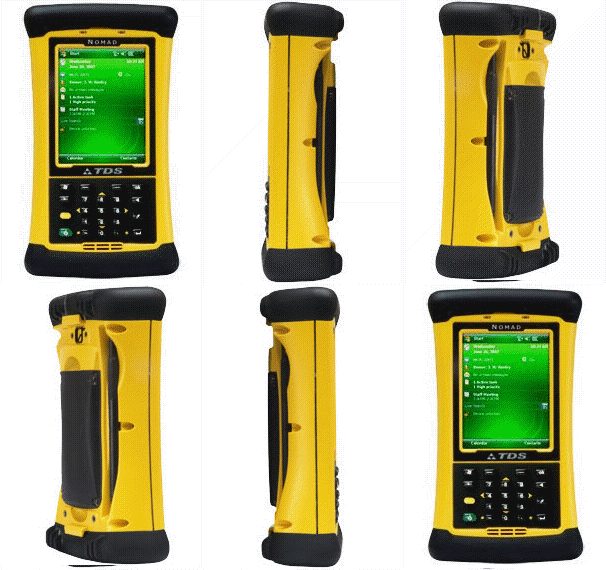
AND WIN A FREE TRIMBLE NOMAD
HANDHELD RUGGED COMPUTER!
Enter now:
http://www.adventuresofgreg.com/HPB/HPBmain.html

Posted by: adventuresofgreg | July 16, 2008

Sonoma bike trip


M5 lowracer touring modification with rear panniers. It’s the way to tour!
(lowtourer or tourracer?)

Helen and I just got back from our self-supported bike tour around Sonoma Valley, CA. Since I needed the recumbent position training benefit from the trip, I fastened a rear rack onto the M5 and clipped my panniers on and hauled all of our clothes and gear. It worked out great – no problems at all aside from being a bit invisible to traffic as I usually am.

We had tons of fun, ate plenty and drank a some really great wine. The hills on the first day were the steepest inclines I have ever ridden and had to walk the steepest parts. The rear panniers with our stuff probably weighed 50 lbs and I don’t have hill climbing gears on the M5. That’s my story and I’m sticking to it. The training effect of powering up those climbs should be good.

It was four days of awesome riding and a long run on the beach thrown in for good measure. See below for some additional photos of our Sonoma trip.

—————————–
24 hour record progress

Emerald Lake in Yoho National Park

It’s kind of coming down to the crunch right now. I would like to attempt the record during the last week of July which leaves me just a couple weeks to get organized. I spent most of the day today doing some research on possible lakes for the record attempt

The photo above is Emerald Lake in Yoho national part which is about 3 hours west of Calgary. The lake is in the wind sheltered region west of the great divide, and is about the perfect size for a 1 km diameter loop. Any lake larger than Emerald tends to create larger waves and ripples with wind. I need to keep the lake as small as possible to minimize the wave size, and as large as possible to keep my circumference route as large as possible. Emerald seems like it is suitable.

But, Emerald lake is in the National Park and I need a permit. I spoke with Rachael at Parks Canada today and she is going to seek permission on my behalf. She told me the only problem she can foresee would be the recent cougar warning for the area. This might make stationing an observer on the far side of the lake in the middle of the night a bit risky. I think that we could station shifts of observers on row boats, canoes or kayaks rather than on shore to deal with the cougar and bear risk.

If Rachael gives me the OK, I need to scout the lake to make sure that it would work for the 24 hour distance record. Then my next issue is finding enough official observers who would be ready at a moments notice to travel out to Emerald and sit in a row boat for 12 hours.

If you would be able to act as an official for any day during the last week in July, or know of anyone who might be able to help, please contact me. greg@justgreg.com or 403-651-2748

If you have not already, please take a couple of minutes to register your distance prediction for me during my attempt. Trimble has donated a Nomad rugged hand held computer for whoever comes the closest to predicting my final finishing distance. It’s free to enter. The entry form is here: http://www.adventuresofgreg.com/PredictContest.html

————————————-
Following my progress during the 24 hour record attempt:

You can follow my progress during the 24 hour record attempt at the blog:

http://www.adventuresofgreg.com/HPB/HPBmain.html

Or you can subscribe to my Twitter feed and get quick updates via email, web or your cell phone during the 24 hour attempt: https://twitter.com/pedaltheocean

I will NOT be using email to post updates, so if you have entered the contest and want to follow my progress, please subscribe to the RSS feed at the blog, watch the blog, or subscribe to the Twitter feed.

—————————————
Photos from Sonoma:


M5 tour-racer and a Sonoma vineyard (click to enlarge)


Helen and her carbon Kestrel Airfoil triathlon bike at our hotel


Big mistake – when you are bike touring,
don’t ever eat at a French restaurant.
This was Helen’s main course.
It consisted on ONE single, solitary, solo, lonely
square inch of fish.

Me and the M5 at Bodega Bay on the coast.


Tan lines. It was 107 degrees everyday for the in-land portion of the trip!
(OK, maybe I am flexing just a bit…)
Posted by: adventuresofgreg | July 15, 2008

enter my contest!

Win a FREE Trimble Nomad® Handheld Computer!
Predict my finishing distance and you can win a free
Trimble Nomad handheld rugged computer.


CreatePublishFrame3(‘71077′,’VXNlcklkPTcxMDc3LkZvcm1JZD0x’,’175′,’230′,’www.formlogix.com’,’https’);

The farthest distance a human has travelled under his own power on flat water is 242 km by Carter Johnson on April 29-30, 2006 on Lake Merced, California using a Huki S1-x surfski kayak. On the week of July 27 to August 2, Canadian Greg Kolodziejzyk is going to challenge Carter’s record using a specially designed, state of the art carbon fiber pedal powered boat called Critical Power 2.

Event sponsor Trimble is offering a free Nomad® handheld computer to whoever can come the closest to predicting Greg’s finishing distance during his attempt at a new 24 hour human powered boat distance record.

The contest is free to enter and open to anyone. Simply fill in your name, email address and distance prediction in miles or kilometers on the form found below.

The new Trimble Nomad handheld computer delivers maximum performance and reliability in a lightweight and extremely rugged design that’s easy to carry. Featuring built-in GPS, color camera, embedded Bluetooth and 802.11g wireless, the waterproof Nomad weighs just 17 ounces, meets military specifications for drops, vibration, and both high and low temperature operation, and runs Windows Mobile 6. With rounded edges to fit comfortably in your hand, the Nomad works wherever and whenever you need it. More information on the amazing Trimble Nomad can be found here.

Contest entrants can follow my progress live during the record attempt here at the BLOG: www.adventuresofgreg.com/HPB/HPBmain.html


Posted by: adventuresofgreg | July 5, 2008

From the lake

.flickr-photo { }.flickr-frame { float: center; text-align: center; margin-right: 15px; margin-bottom: 15px; }.flickr-caption { font-size: 0.8em; margin-top: 0px; }

From the lake
From the lake,
originally uploaded by adventuresofgreg.

A mixed day. A bit of rain, some wind, some waves, some mirror flat. I was testing some outrigger braces to stop them from flopping around so much. I’m not sure they make much of a difference. I did get 11.6 kph ave on my first out and back, but it was pretty calm then. Can’t say for sure what caused the good measurement. The one thing – do realize is that absolutely flat mirror conditions are way, way faster than anything else.
Sent from my BlackBerry device on the Rogers Wireless Network

Posted by: adventuresofgreg | July 3, 2008

Hello from the lake

Posted by: adventuresofgreg | July 2, 2008

Thunderstorms

Training is going well, but the weather isn’t exactly cooperating. I did a 3 hr hard & fast ride last night and got caught in the worst electrical storm. Total down pour mixed with hail and thunder and lightening all around me. I got drenched and wasn’t really anywhere convenient to pull over, so I just hammer through.

Same thing today, but this time I was on Glebmore res. Luckily it’s just warm enough outside to stay warm through it by stoking the furnace with about 250 watts.

I’m trying to get out to the lake for as much training as possible this week because Helen and I are cycling Sonoma in California next week. I’ll be on the M5 for that.

I got some decent speeds today on Glenmore despite the rough water due to the winds. 11.3 kph average speed for a 5.8 km loop of the entire lake at 150 watts. most of the lake was ripples with sections of 6 to 8″ waves, and even some waves breaking over the deck. Updated speed data below:

Speed data:

date lake power watts wind kph waves rudder prop loop size km loop dir other SPEED kph
06/05/08 elbow 150 5 ripples big thin .5 counter
11.1
06/09/08 elbow 150 calm flat big thin .5 counter
11.2
06/09/08 elbow 150 calm flat small thin .5 counter
11.7
06/09/08 elbow 150 calm flat small thick .5 counter
11.7
06/09/08 elbow 150 calm flat small thin .5 counter prop strut pulled into hull with cord 11.6
06/09/08 elbow 150 calm flat none thin .5 counter
11.8
06/09/08 elbow 150 calm flat small thin .5 clock
11.1
06/09/08 elbow 150 10 ripply small thin .5 counter
11.5
06/12/08 elbow 150 20 waves big thin .5 counter
11.0
06/09/08 elbow 150 20 waves big thick .5 counter
10.9
06/09/08 elbow 150 20 waves small thick .5 counter
11.3
06/09/08 elbow 150 20 waves small thin .5 counter skimmer 10
06/09/08 elbow 150 20 waves small thin .5 counter skimmer 10.2
06/16/08
elbow
150
calm
flat
small
thin
.5
counter
flex shaft & freehub
11.9
06/16/08 elbow 150 calm flat small thin .5 counter flex shaft & freehub 11.8
06/16/08 elbow 100
calm
flat
small
thin
.5
counter
flex shaft & freehub 10.3
06/16/08 elbow 200 calm flat small thin .5 counter flex shaft & freehub 13.2
06/16/08 Glenmore
150
calm flat small thin 2
out&back
flex shaft & freehub 11.1
06/16/08 Glenmore 150 calm flat small thin 2.6
out&back
flex shaft & freehub 11.1
06/16/08 Glenmore 150 calm flat small thin 1.35
counter
flex shaft & freehub 10.9
06/16/08 Glenmore 150 10
ripply
none
thin
.84
counter
flex shaft & freehub 11.6
06/16/08 Glenmore 150 10 ripply big
thin
.8
counter
flex shaft & freehub 11.1
06/17/08 Ghost
150
5
ripply
small
thin
.8
out&back
flex shaft & freehub 11.6/11.2 = 11.4
06/17/08 Ghost 150 5 ripply small thin .52 counter flex shaft & freehub 11.5
06/17/08 Ghost 150 5 ripply small thin .56 clock flex shaft & freehub 11.6
06/17/08 Ghost 150 10 ripply small thick 1 out&back flex shaft & freehub 11.7/11.2 = 11.4
06/17/08 Ghost 150 10 ripply small thick .7 out&back flex shaft & freehub. NO PROP STRUT
11.8/11.2 = 11.5
06/28/08 U Kanan
150 10 waves, ripples,
some calm
small thin 7.19 out&back flex shaft 11
06/28/08 U Kanan 150 5 ripples
small thin 1.19 clock flex shaft 11.5
06/28/08 U Kanan 150 5 ripples small thin 1.13 counter flex shaft 11.5
06/28/08 U Kanan 150 10 waves, ripples
small thin 10.3 giant loop of lake – counter
flex shaft 11
06/28/08 U Kanan 120 10 waves, ripples,
small thin 10.1 giant loop of lake – clock flex shaft 10.1
06/28/08 U Kanan 120 5 ripples

small thin 1 clock flex shaft 10.5
06/28/08 U Kanan 100 5 ripples small thin 1 clock flex shaft 9.6
07/01/08 Glenmore 150 5-10 6 to 8″ waves
small thick 2 out & back
flex shaft, alum spiners,
heavy boat
11.3
07/01/08 Glenmore 150 5-10 8″ waves small thick 6 clock loop entire lake
flex shaft, alum spiners,
heavy boat
11.3
07/01/08 Glenmore 150 5 ripples
small thick .8 out & back
flex shaft, alum spiners,
heavy boat
11.4
07/02/08 Glenmore 150 10-15 wavey small thin .8 out & back flex shaft, alum spiners,
heavy boat
11.3
07/03/08 Glenmore 150 0 calm small thick 1.5 out & back (same above)
heavy boat
11.5
07/03/08 Glenmore 150 0 calm small thick 5.6 counter loop
(same above)
heavy boat
11.4
07/03/08 Glenmore 200 5-10 ripples, waves
small thick 5.6 clock loop
(same above)
heavy boat
12.4
07/03/08 Glenmore 120 5-10 ripples, waves small thick 5.6 clock loop
(same above)
heavy boat
10.4
Observations
1. Every 5 kph of wind equates to .1 kph decrease in speed
2. Big rudder is .6 kph slower than small rudder. Small rudder is .1 kph slower than no rudder
4. Paint vs packing tape was worth a speed increase of .1 kph
5. Elliminating the prop strut is worth an additional .1 kph in speed.
6. Counter clockwise loops at Elbow Valley lake are worth an additional .2 to .3 kph average speed due to current.
7. remove the seals and backing off the lock-nuts on the gear box are worth an additional .1 kph average speed.
8. The narrowed 1/4″ spring steel shaft compared to the 3/8″ stainless shaft is worth .1 kph speed increase

k

Posted by: adventuresofgreg | June 29, 2008

WOW! Spectacular day!


Long training day on upper Kananaskis Lake

What an amazing day! I met Chris Comfort at Upper Kananaskis lake on Saturday morning and spent the next 4 hours collecting speed and power data by blasting around the large 10 km circumference lake on Critical Power 2 (yes, it now has an official name and logo – perhaps you recognize it?)

Things look OK – not super great, but good enough to move forward with my plans for an attempt at the 243 km human powered boat distance record.

The big problem is I realize that WIND is a huge issue around here. I will NOT be able to find a day with zero winds. On the very best weather day, I can probably expect glassy conditions at dust, dawn, perhaps during most of the night, but mid-afternoon there will always be at least 5 to 10 kph winds.

I think my 24 hour record venue lake has to be small enough NOT to allow 5 to 10 kph winds to build up big waves. Upper Kananaskis lake is large and the winds only ever got to 5 to 10 yesterday (when they were easily 15 to 20 in the city), but the waves were over 1 foot high with white caps. On my long, 10 km loops around the circumference of the lake I often got tossed around quite a bit and the wind really does suck speed away. I have always measured better test results from doing small loops in small lakes because even with a 5 to 10 kph wind, the waves never get beyond ripples. A ripple in a small lake becomes a 1 foot wave in a large lake.

Here is the data for the Kananaskis lake day:

  1. 10 km circumference of the entire lake, 150 watts, 5 to 10 kph winds, waves at times, dead calm at other times, very windy at times = 11 kph average (I repeated this TWICE and got the exact same average)
  2. Same loop as above, same mixed conditions but with 120 watts average power (this is what my overall average power expectation will be for 24 hours) = 10.1 kph (that’s 242 km total in 24 hours)
  3. Small, 1 km loop in protected bay. It was still 5 to 10 kph winds, but water was ripply rather than wavy. 150 watts = 11.5 kph (repeated this both directions with same average)
  4. Small, 1 km protected loop at 120 watts (my goal wattage for 24 hours) = 10.5 kph (255 km over 24 hours)
  5. Small, 1 km protected loop at 100 watts = 9.6 kph (230.4 km over 24 hours)

At Elbow Valley lake, the best I measured during calm conditions was 11.8 kph for a 150 watt .5 km loop. If I subtract .3 for the current, that would equal 11.5 which was what I got at Kananaskis yesterday for 5 to 10 kph windy day. I can probably ADD .2 kph for a windless day and I would be at 11.7 which is .2 kph higher than the best I was getting at Elbow. The .2 kph gain could be due to the freeing up of the gear box.

lunch break with Chris

I cannot use the lake at Elbow anymore for a control! I went out there the day before yesterday and the weeds are growing up to the SURFACE! I did not get one single run in without having to stop to tear weeds off the prop. I think that same thing was happening at Ghost and Glenmore which was why I was getting such poor test results. There was an article in the paper last week about weed growth in local area lakes being a big problem this year.

TRAINING

The 4 hour solid effort yesterday was a good experience for me, and I realize that spending more time training in the boat is necessary. There is a subtle difference between pedaling on my M5 road recumbent and the boat, and I didn’t ‘feel’ it until after I was finished yesterday. In preparation for the 24, I have been doing plenty of single leg drills on my M5 rides. I am now able to go almost indefinitely with one leg on the M5. This has been good to strengthen and reinforce my CIRCLING, but it is still different that on the boat.

With the bike, I have momentum from a ‘push’ pedal stroke that carries through to the ‘pull’ portion of the pedal stroke. During the pull, I can take advantage of the previous push force, and most of my pulling effort is just lifting the weight of the leg around. On the boat, there is far LESS momentum due to the increased drag of the water. For the portion of the pedal stroke (VERY small portion, but it is still there) where a single leg is doing some pulling, there is a greater resistance and therefore more effort during that phase. It adds up over time. The test to really feel this is to compare a single leg drill on both the M5 recumbent and the boat. It is much easier to keep a higher wattage on the M5 with one leg than it is on the boat because I take take advantage of my powerful PUSH muscles on the M5, whereas on the boat, I must recruit weaker PULL muscles slightly more often – like I said, over time it adds up.

I am starting to experience some of the same issues that I experienced last year, and earlier this year – sore knees and sore Achilles again. This makes sense because the portion of the pedal stroke that is not being assisted by the opposite leg the most, is near the top – the ’rounding over’ of the pedal. This action to the leg, is like kicking a soccer ball and directs more stress to the knee – the same road bike geometry as an extreme seat-forward position which is known to cause knee problems. The opposite leg is doing the same from below, but it is the Achilles that is doing the work.

Not that I would bother trying this at this point, but I believe the easy solution would be to incorporate a fly wheel into the drive. And no, I don’t think the freewheel helps because this is all happening way to fast for the pawls to kick in. The more difficult solution is to continue to train into this geometry.


Speed data:

date lake power watts wind kph waves rudder prop loop size km loop dir hull floats other SPEED kph
06/05/08 elbow 150 5 ripples big thin .5 counter taped norm
11.1
06/09/08 elbow 150 calm flat big thin .5 counter painted norm
11.2
06/09/08 elbow 150 calm flat small thin .5 counter painted norm
11.7
06/09/08 elbow 150 calm flat small thick .5 counter painted norm
11.7
06/09/08 elbow 150 calm flat small thin .5 counter painted norm prop strut pulled into hull with cord 11.6
06/09/08 elbow 150 calm flat none thin .5 counter painted norm
11.8
06/09/08 elbow 150 calm flat small thin .5 clock painted norm
11.1
06/09/08 elbow 150 10 ripply small thin .5 counter painted norm
11.5
06/12/08 elbow 150 20 waves big thin .5 counter painted norm
11.0
06/09/08 elbow 150 20 waves big thick .5 counter painted norm
10.9
06/09/08 elbow 150 20 waves small thick .5 counter painted norm
11.3
06/09/08 elbow 150 20 waves small thin .5 counter painted skimmers rods 10
06/09/08 elbow 150 20 waves small thin .5 counter painted skimmers no rods 10.2
06/16/08
elbow
150
calm
flat
small
thin
.5
counter
painted
norm
flex shaft & freehub
11.9
06/16/08 elbow 150 calm flat small thin .5 counter painted norm flex shaft & freehub 11.8
06/16/08 elbow 100
calm
flat
small
thin
.5
counter
painted
norm
flex shaft & freehub 10.3
06/16/08 elbow 200 calm flat small thin .5 counter painted norm flex shaft & freehub 13.2
06/16/08 Glenmore
150
calm flat small thin 2
out&back
painted
norm
flex shaft & freehub 11.1
06/16/08 Glenmore 150 calm flat small thin 2.6
out&back
painted norm flex shaft & freehub 11.1
06/16/08 Glenmore 150 calm flat small thin 1.35
counter
painted norm flex shaft & freehub 10.9
06/16/08 Glenmore 150 10
ripply
none
thin
.84
counter
painted
norm
flex shaft & freehub 11.6
06/16/08 Glenmore 150 10 ripply big
thin
.8
counter
painted
norm
flex shaft & freehub 11.1
06/17/08 Ghost
150
5
ripply
small
thin
.8
out&back
painted
norm
flex shaft & freehub 11.6/11.2 = 11.4
06/17/08 Ghost 150 5 ripply small thin .52 counter painted norm flex shaft & freehub 11.5
06/17/08 Ghost 150 5 ripply small thin .56 clock painted norm flex shaft & freehub 11.6
06/17/08 Ghost 150 10 ripply small thick 1 out&back painted norm flex shaft & freehub 11.7/11.2 = 11.4
06/17/08 Ghost 150 10 ripply small thick .7 out&back painted norm flex shaft & freehub. NO PROP STRUT
11.8/11.2 = 11.5
06/28/08 U Kanan
150 10 waves, ripples,
some calm
small thin 7.19 out&back painted norm flex shaft 11
06/28/08 U Kanan 150 5 ripples
small thin 1.19 clock flex shaft 11.5
06/28/08 U Kanan 150 5 ripples small thin 1.13 counter flex shaft 11.5
06/28/08 U Kanan 150 10 waves, ripples
small thin 10.3 giant loop of lake – counter
flex shaft 11
06/28/08 U Kanan 120 10 waves, ripples,
small thin 10.1 giant loop of lake – clock flex shaft 10.1
06/28/08 U Kanan 120 5 ripples

small thin 1 clock flex shaft 10.5
06/28/08 U Kanan 100 5 ripples small thin 1 clock flex shaft 9.6
06/28/08 Glebmore 150 5-10 6 to 8″ waves
small thick 2 out & back
flex shaft, alum spiners
11.3
06/28/08 Glebmore 150 5-10 8″ waves small thick 6 clock loop entire lake
flex shaft, alum spiners 11.3
06/28/08 Glebmore 150 5 ripples
small thick .8 out & back
flex shaft, alum spiners 11.4
Observations
1. Every 5 kph of wind equates to .1 kph decrease in speed
2. Big rudder is .6 kph slower than small rudder. Small rudder is .1 kph slower than no rudder
3. Right hand turns dramatically slow the boat down.
4. Paint vs packing tape was worth a speed increase of .1 kph
5. Elliminating the prop strut is worth an additional .1 kph in speed.
6. Counter clockwise loops at Elbow Valley lake are worth an additional .2 to .3 kph average speed due to current (??? need to verify)
7. remove the seals and backing off the lock-nuts on the gear box are worth an additional .1 kph average speed.
8. The narrowed 1/4″ spring steel shaft compared to the 3/8″ stainless shaft is worth .1 kph speed increase

« Newer Posts - Older Posts »

Categories

Design a site like this with WordPress.com
Get started